
Triangle Calculator Right Angle
A right triangle is fully determined by any two measurements other than the right angle itself — two sides, or a side and an angle. Enter what you know and this calculator finds everything else, explains each step with Pythagoras’ theorem or SOH-CAH-TOA, and draws the triangle to scale.
- Free to use
- No sign-up
- Runs in your browser
Right triangle calculator
Fill in exactly two values (at least one must be a side), leave the rest blank.
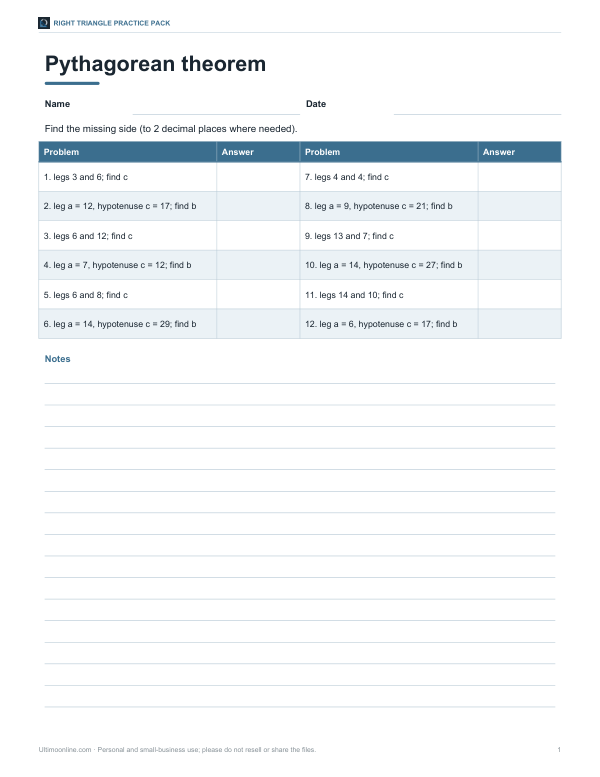
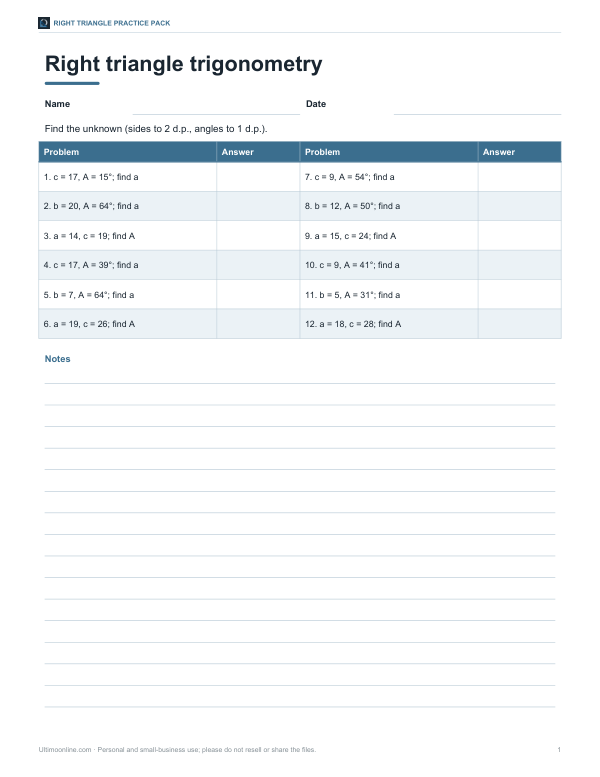
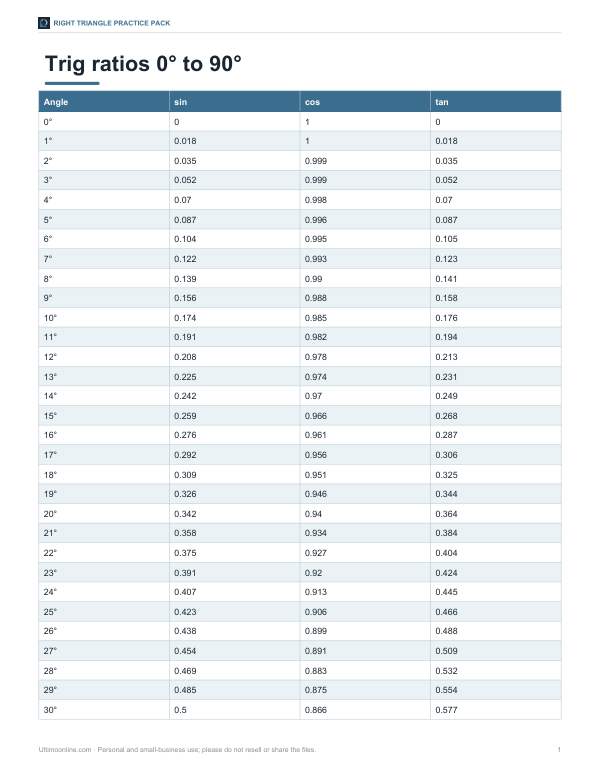
Right Triangle Practice Pack
Printable right triangle worksheets (Pythagoras and SOH-CAH-TOA) with worked answer keys, a trig ratio table from 0° to 90°, a Pythagorean triples list and a formula card.
- Pythagoras worksheet (PDF/DOCX)
- Trig worksheet (PDF/DOCX)
- Trig table (PDF/XLSX)
- Triples list (PDF)
- Formula card (PDF)
Formats: PDF, DOCX, XLSX. Instant download after payment (link valid 72 hours, up to 5 downloads). AI-assisted: the templates were drafted with AI help and reviewed and laid out before publishing.
$3.00 USD, one-time 5 files · about $0.60 each
- Instant download
- 7-day refund
- Secure checkout by Stripe
7-day money-back guarantee. Full refund within 7 days of purchase, even after you download.
Free sample: Pythagoras Worksheet (PDF, 98 KB)
Full refund within 7 days — see the refund policy and license.
Free printables
Single sheets you can print right now, no sign-up. The full pack adds every sheet in one download plus the editable files.
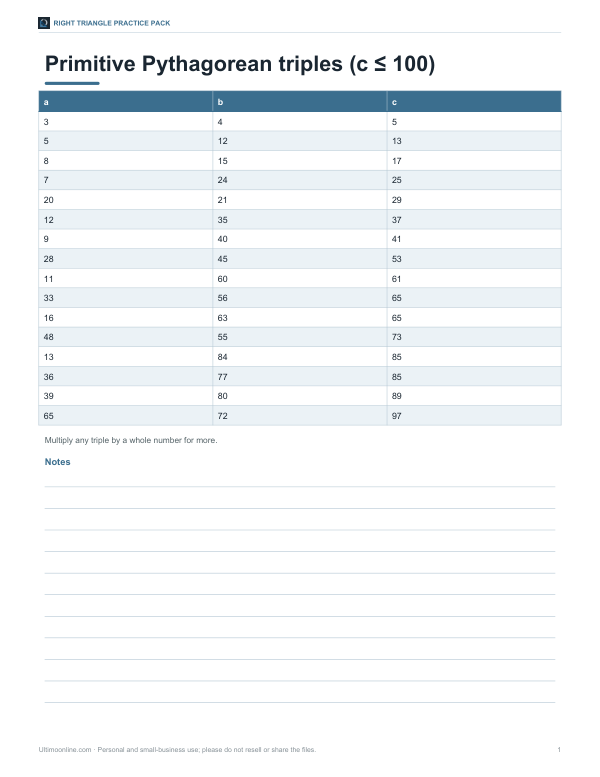 Printable Right Triangle Triples List
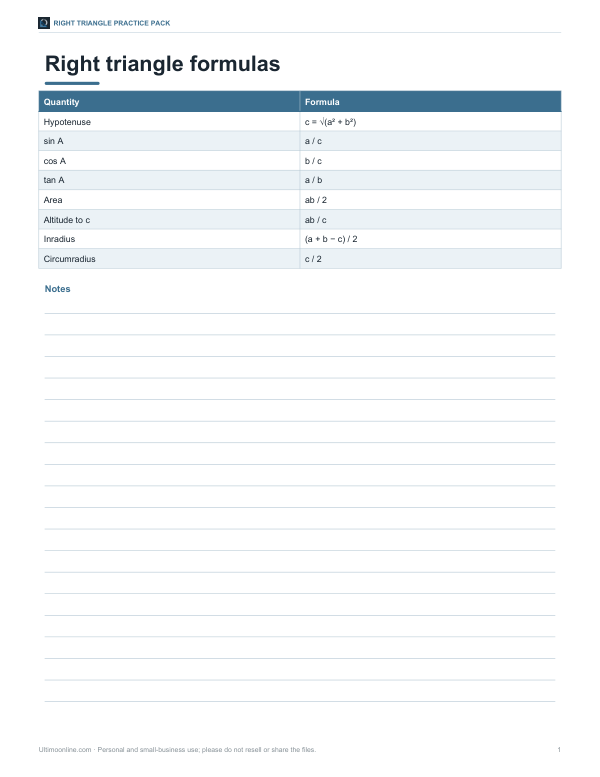 Printable Right Triangle Formula Chart
The formulas
| What you know | Formula |
|---|---|
| Two legs a, b | c = √(a² + b²); A = tan⁻¹(a/b) |
| Leg and hypotenuse | other leg = √(c² − leg²); A = sin⁻¹(a/c) |
| Leg a and angle A | c = a / sin A; b = a / tan A |
| Leg b and angle A | c = b / cos A; a = b · tan A |
| Hypotenuse and angle A | a = c · sin A; b = c · cos A |
| Either acute angle | The other is 90° minus it |
Labels: legs a and b meet at the right angle C; the hypotenuse c is opposite it. Angle A is opposite side a and angle B opposite side b.
SOH-CAH-TOA
For an acute angle in a right triangle: sin = opposite ÷ hypotenuse (SOH), cos = adjacent ÷ hypotenuse (CAH) and tan = opposite ÷ adjacent (TOA). For angle A, the opposite side is a and the adjacent side is b. To find an angle from two sides, use the inverse functions sin⁻¹, cos⁻¹ or tan⁻¹ — on most calculators, SHIFT or 2nd followed by sin, cos or tan.
Worked example
A ladder must reach a window 4 m up, with its foot 3 m from the wall. Enter a = 4 and b = 3: the calculator gives c = √(16 + 9) = 5 m of ladder, the angle with the ground A = tan⁻¹(4/3) ≈ 53.13° (angle A is opposite the height a), and the angle at the top B ≈ 36.87°. The area of the triangle under the ladder is 6 m². Many ladder safety guides recommend roughly a 4-to-1 ratio of height to base — about 75° — so the user moves the foot closer: with a = 4 and angle A = 75° (so B = 15°), the base b becomes about 1.07 m and the ladder length c about 4.14 m.
Pythagorean triples
| a | b | c |
|---|---|---|
| 3 | 4 | 5 |
| 5 | 12 | 13 |
| 8 | 15 | 17 |
| 7 | 24 | 25 |
| 20 | 21 | 29 |
| 12 | 35 | 37 |
| 9 | 40 | 41 |
| 28 | 45 | 53 |
| 11 | 60 | 61 |
| 33 | 56 | 65 |
| 16 | 63 | 65 |
| 48 | 55 | 73 |
| 13 | 84 | 85 |
| 36 | 77 | 85 |
| 39 | 80 | 89 |
| 65 | 72 | 97 |
Primitive Pythagorean triples with hypotenuse up to 100. Any multiple of a triple — 6, 8, 10 or 9, 12, 15 — is also a right triangle, a trick builders use to check square corners with a tape measure.
Special right triangles
| Triangle | Side ratios | Angles |
|---|---|---|
| 45-45-90 | 1 : 1 : √2 | 45°, 45°, 90° |
| 30-60-90 | 1 : √3 : 2 | 30°, 60°, 90° |
| 3-4-5 | 3 : 4 : 5 | about 36.87°, 53.13°, 90° |
The 45-45-90 triangle is half a square cut along its diagonal; the 30-60-90 triangle is half an equilateral triangle.
Real-world uses
| Job | What you know | What you find |
|---|---|---|
| Checking a square corner | Two sides of 3 ft and 4 ft | The diagonal should be exactly 5 ft |
| Roof pitch | Rise 6 in over run 12 in | Roof angle ≈ 26.57° and rafter length per foot of run |
| Ramp design | Rise 30 in, slope 1:12 | Run 30 ft; ramp length ≈ 30.1 ft |
| TV screen size | Width and height | Diagonal (the advertised size) |
| Distance across a field | Two perpendicular distances walked | The straight-line distance |
| Height of a tree | Distance to the tree and angle to the top | Height = distance × tan(angle), plus eye height |
In each case the right angle is between the two known perpendicular measurements, and the calculator finds the rest.
Common mistakes
- Using the hypotenuse as a leg — the hypotenuse is always the longest side, opposite the right angle.
- Calculator in radians instead of degrees when using sin, cos or tan.
- Mixing up opposite and adjacent: they depend on which angle you are using.
- Rounding intermediate results too early.
- Forgetting that the two acute angles must add up to 90°.
Checking your answer
After solving, check that a² + b² equals c² (allowing for rounding), that A + B = 90°, and that the side opposite the larger angle is the longer leg. The steps panel shows each formula with your numbers, so you can follow along or copy the working into homework.
Other properties
- The altitude to the hypotenuse equals ab / c and splits the triangle into two smaller triangles similar to the original.
- The circumcentre is the midpoint of the hypotenuse, so the circumradius is c / 2.
- The inradius is (a + b − c) / 2.
- The median to the hypotenuse is also c / 2.
Privacy
All calculations run in your browser.
Frequently asked questions
How do I find the hypotenuse?
c = √(a² + b²).
How do I find a missing angle?
Use inverse trig: A = tan⁻¹(a/b) or sin⁻¹(a/c).
Can I solve with just two angles?
No — you need at least one side to know the size.
What are the angles of a 3-4-5 triangle?
About 36.87°, 53.13° and 90°.
How do I find the area?
Half the product of the two legs: ab ÷ 2.
Does it work in degrees?
Yes — angles are entered and shown in degrees.
Which side is the hypotenuse?
The longest side, opposite the right angle.
Can a right triangle have two right angles?
No — the other two angles must add up to 90°.
What is the altitude to the hypotenuse?
The perpendicular from the right angle to the hypotenuse; its length is ab ÷ c.
How do I check a corner is square?
Measure 3 and 4 units along the two sides; the diagonal should be exactly 5.
What if my two values don’t make a triangle?
The calculator explains the problem — for example, a leg longer than the hypotenuse.